

Why Most Indie Hacker Side Projects Fail (and What Actually Works in 2026)
Most indie hacker side projects fail in 2026. Discover why and learn the evidence-backed, portfolio-based approach that actually works for profitability.

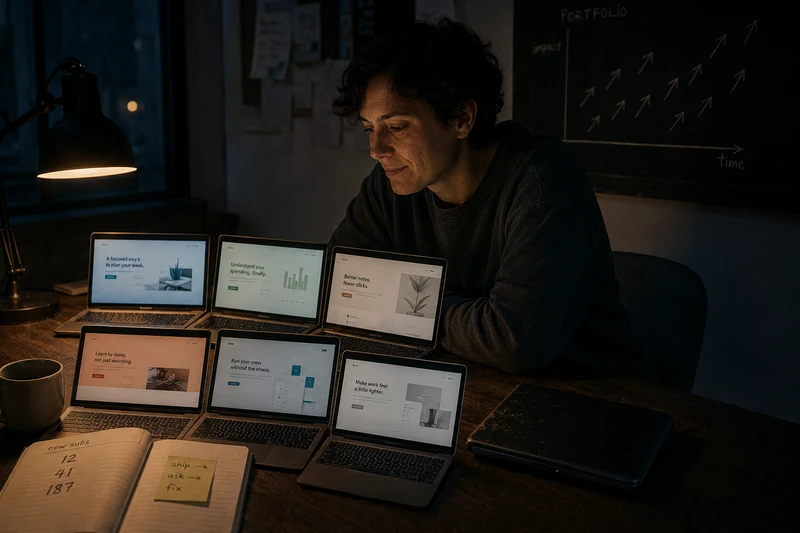
Hopeful but anxious—that’s most of us when we start a side project. The dream is alive: a little tool, a SaaS, maybe a newsletter. But lurking beneath the optimism is a nervous question nobody wants to say out loud: What if this is just another abandoned repo? Here’s the boring version that actually works: you can absolutely win as an indie hacker in 2026, but the path looks nothing like the unicorns you see on Twitter.
Most Indie Hacker Side Projects Fizzle Out Within 18 Months
Let’s get real about the numbers. The majority of indie hacker side projects don’t make it. According to Indie Hackers’ own survey, 80%+ of side projects are not profitable within 12 months (Why Side Projects Fail: Learnings from Indie Hackers). The story gets even bleaker for indie SaaS: most of these projects are abandoned within their first couple of years.
Nobody writes about this because it isn’t glamorous: most projects fade into obscurity, not in a blaze of pivot glory, but in a slow drip of unread emails and un-renewed Stripe subscriptions. The unsexy answer is that side projects fail quietly, and fast.
“The majority of side projects fail, not because of bad ideas, but because founders don’t validate the market or underestimate marketing efforts.”
— Courtland Allen, Founder, Indie Hackers
So if you feel like you’re treading water with your launch or your first $50 MRR, you’re not alone. The odds are stacked, but not for the reasons you might think.
Lack of Market Validation and Underestimating Marketing: The Real Killers
Here’s the part almost nobody preparing their first product wants to hear: the number one reason for side project failure is not a lack of hustle, but building something nobody needs. According to CB Insights, 42% of failed startups cite ‘no market need’ as the primary reason (The Top 20 Reasons Startups Fail).
Founders, especially technical ones, tend to skip validating the market. It’s much more fun to ship code than to ask uncomfortable questions. But as Indie Hackers’ own podcast guests reveal, most people dramatically underestimate how hard it is to get anyone to care—let alone pay—for their tool:
“A lot of indie hackers underestimate how hard it is to market a product, even if it’s technically excellent.”
— Indie Hackers Podcast
The myth of “build it and they will come” lingers on, but the graveyard of side projects says otherwise. The honest description is low-maintenance income. The maintenance still exists—especially when it comes to keeping your users interested. Without validation and marketing, you’re not betting on a product, you’re betting on a lottery ticket.
Time Pressure and Motivation: The Silent Project Killers
You don’t have to be a founder to know this feeling: the day job, the side project, the kids, and—wait, is it already next quarter? Time is the silent killer of indie dreams. According to peer-reviewed research in the ACM Digital Library, 67% of side project developers cite ‘lack of time’ as the main reason for stopping (Why Do So Many Side Projects Fail? (Academic Paper)).
“Our survey found that 67% of side project developers cite ‘lack of time’ as the primary reason for abandonment.”
— Dr. Margaret-Anne Storey, Professor of Computer Science, UVic; ACM Researcher
It’s not just about time—it’s about energy. Burnout comes for the solo founder faster than any technical challenge. Most projects don’t die because the tech was too hard, but because motivation ran out long before the user sign-ups rolled in. This isn’t a flaw in your character; it’s a predictable pattern. Portfolios survive. Single bets do not—statistically.
Audience-First, Rapid Iteration, and Realistic Maintenance: What Actually Works
Here comes the part where things turn around. Indie hackers who build an audience first consistently report much higher success rates than those who “build in silence.” That means starting with a newsletter, a Twitter thread, or even a Discord group—anything that gets real people talking to you before you ship code.
“Iterating quickly based on user feedback made the difference between failure and traction.”
— Ryan Hoover, Founder, Product Hunt
Rapid feedback doesn’t just save time, it preserves motivation. Every user reply is a tiny dopamine hit—proof your thing matters to someone. And here’s the boring version that actually works: set realistic expectations for maintenance. Low-maintenance income exists, but “set and forget” is a lie.
If you’re ready to act on this, don’t reinvent the wheel. Try these vetted tools to streamline market validation and build your early audience while keeping side project maintenance realistic. Introduce curated tools or platforms that help indie hackers validate ideas, build audiences, and automate feedback collection (e.g., prelaunch landing page builders, audience analytics, or low-maintenance email marketing tools). Try these vetted tools to streamline market validation and build your early audience while keeping side project maintenance realistic.
Portfolios Outperform Big Bets: Multiple Small Wins Beat Unicorn Chasing
The VC-funded founder and the FIRE-seeking founder want completely different things. If you’re in the indie hacker camp, betting everything on one project isn’t just risky—it’s statistically a losing game. Most solo founders who stick around do it by diversifying across a portfolio of small, validated projects (Why Side Projects Fail: Learnings from Indie Hackers).
Nobody writes about this because it isn’t glamorous: it’s the story of durable, modest wins accumulating into sustainable income. The unicorn myth is seductive, but the reality is that multiple little bets—each validated, each low-maintenance—add up to a life-changing portfolio. Survivorship bias is real, so don’t just mimic the one-in-a-million; build the odds in your favor.
Empowered yet? This isn’t about luck, charisma, or burning out for a shot at the big leagues. It’s about stacking the deck with boring, resilient habits: audience-first, feedback-fueled, portfolio-driven. That’s what actually works in 2026. Subscribe for more evidence-backed strategies and real-world case studies on building resilient portfolios of indie products.
What’s your biggest challenge with side projects—market validation, marketing, or time? Share your story below.
Sources
Keep reading

Can a Non-Coder Actually Ship With Cursor? A Developer’s Honest Test
Cursor is not no-code. Here is what a non-technical founder can realistically ship in weeks — and when you still...
Self-Hosting n8n: The Real Cost vs Cloud (and the 6 hrs/week DevOps Tax)
A founder-facing TCO teardown of n8n Cloud vs self-hosted infra — including the DevOps hours nobody puts in the spreadsheet.

reMarkable vs Boox vs Kindle Scribe: Which One Actually Replaces the Note Vault You Abandoned?
An honest, spec-and-review-based comparison of reMarkable, Boox, and Kindle Scribe for anyone who quit Obsidian or Notion and wants notes...

6 Books That Actually Changed How I Run a One-Person Business (2026)
Not a top-20 listicle. Six books I actually read and applied while running a one-person AI business, and the one...

Do Phone Lock Boxes Actually Work for Founder Focus? The Commitment-Device Case
A clear-eyed look at whether phone lock boxes help a one-person founder focus — grounded in commitment-device research, with free...
The ‘Second Brain’ is Over: Why You Need a Second Executioner
Stop hoarding notes and start shipping. Discover why the Second Brain fails and how the Second Executioner model uses Personal...
You've reached the end — no more posts to load.
No comments yet — be the first to share your thoughts.