

Self-Hosting n8n: The Real Cost vs Cloud (and the 6 hrs/week DevOps Tax)
A founder-facing TCO teardown of n8n Cloud vs self-hosted infra — including the DevOps hours nobody puts in the spreadsheet.


If you are a solo founder running five to twenty workflows and trying to decide whether to pay n8n for hosting or run your own box, the real question is not self host n8n cost vs cloud on a spreadsheet alone. It is whether you can afford the DevOps tax on top of the invoice. I have shipped automations for my own products, client projects, and internal ops stacks. The pattern is always the same: cloud feels expensive until something breaks at 11pm on a Sunday, and self-hosting feels cheap until you realize you are now the on-call engineer for a tool that was supposed to save you time.
This post is written from an operator lens, not an enterprise IT blog. I am not optimizing for a team of fifty with a dedicated platform group. I am talking about you: the founder who wires up lead routing, content pipelines, CRM syncs, and AI agent handoffs because hiring a full-time DevOps person is not on the roadmap. We will walk through what each option actually costs in dollars, what it costs in founder hours, and when the tradeoff genuinely flips.
Why Founders Care About Self Host n8n Cost vs Cloud
n8n sits in a sweet spot for technical founders. It is visual enough to move fast, flexible enough to drop into JavaScript when Zapier-style limits choke you, and self-hostable when execution caps start feeling like a tax on growth. But sweet spots have thorns. n8n Cloud bills on executions. Self-hosted Community Edition bills on your attention span.
Most pricing comparisons stop at infrastructure. That is incomplete math. When you self-host, you inherit a part-time job: updates, SSL renewals, backup verification, disk space alerts, credential rotation after a scare, and the occasional “why did this webhook stop firing” rabbit hole. None of that shows up on your Hetzner invoice. It shows up in your calendar.
I think about automation spend the same way I think about replacing a VA with AI agents: the sticker price is never the full line item. You are buying back time, but only if the system stays boring. Boring is underrated. Boring is profitable.
The Three Buckets Every Founder Should Model
Before you pick a hosting path, split the decision into three buckets. Infrastructure is the easy one. Labor is where founders lie to themselves. Risk is the one they forget until production traffic depends on a cron job nobody documented.
- Infrastructure cash cost — VPS, managed pod, or n8n Cloud subscription. This is what shows up in your accounting software.
- Founder time tax — setup, monitoring, incident response, and the quarterly “I should really upgrade n8n” task you keep snoozing.
- Execution and concurrency risk — on Cloud, you hit caps. Self-hosted, you hit memory limits or database bloat. Different failure modes, same outcome: workflows stop.
If you only compare bucket one, self-hosting always wins on paper. If you include bucket two honestly, Cloud Starter at €20–24/month starts looking rational for founders under roughly 2,500 executions who value sleep over savings.
Operator rule: If you cannot name who is on-call when n8n goes down, you are on-call. Budget accordingly.
n8n Cloud Pricing: What You Actually Get
According to n8n’s official pricing page (as of 2026), Cloud plans are priced in euros with roughly 17% savings on annual billing. The numbers that matter for solo founders are Starter and Pro.
- Starter: €20/month billed annually, or €24/month on monthly billing. Includes 2,500 workflow executions per month, 5 concurrent executions, unlimited users, unlimited active workflows, and forum support.
- Pro: €50/month billed annually, or €60/month on monthly billing. Includes 10,000 executions, 20 concurrent executions, workflow history, global variables, admin roles, and 7-day insights.
Both tiers include a 14-day free trial without a credit card on Starter and Pro. Data is hosted in the EU (Frankfurt). For a founder running lead capture, newsletter triggers, and a handful of internal sync workflows, Starter is often enough until you start chaining AI calls or polling APIs aggressively.
The trap is not the monthly fee. It is the execution ceiling. A workflow that fires every fifteen minutes on a polling node burns roughly 2,880 executions per month before you add anything else. One “simple” monitoring workflow can eat your entire Starter allowance. That is when founders start doing back-of-napkin math and googling Hetzner pricing at midnight.
When Cloud Is the Rational Default
Pay for n8n Cloud when any of these are true:
- You are still validating whether n8n fits your stack. The trial and zero-setup path reduce friction.
- Your workflows are not business-critical yet. Downtime is annoying, not revenue-threatening.
- You are under ~2,500 executions/month and not growing fast enough to blow past caps next quarter.
- Your hourly opportunity cost is high and you have no desire to SSH into anything ever.
I have recommended Cloud to founders who are pre-revenue and need to ship a demo automation this week. Paying €24 to avoid a forty-five-minute Docker rabbit hole is often correct. Pride is expensive.
Self-Hosted DIY: The Hetzner Path
The DIY route means running n8n Community Edition on infrastructure you control. Public writeups in 2026 — including detailed breakdowns on DEV Community by vikasprogrammer — consistently land on Hetzner CX22-class VPS instances in the $4–5/month range (roughly €3.99–4.51/month for 2 vCPU and 4GB RAM). Docker Compose, a reverse proxy for HTTPS, and a volume for persistent data is the standard stack.
The cash savings are real. Unlimited executions on Community Edition means your polling workflows do not meter you into panic. Community nodes are available self-hosted, which matters if you rely on integrations not blessed on Cloud Starter. You own the database. You own the credentials. For client work or anything touching PII, that ownership is not vanity — it is liability management.
The catch is everything else. First-time setup commonly takes 45–90 minutes if you have done it before, longer if certbot, firewall rules, and backup scripts are new to you. Ongoing maintenance is where founders underestimate. Community discussions and operator writeups commonly cite 1–2 hours per month for light maintenance; when you factor in monitoring, backup restores, and the occasional upgrade that breaks a node, a realistic planning range for a solo operator is 4–6 hours per month — what I call the founder time tax.
What the DIY Stack Actually Involves
A minimal production-minded setup usually includes:
- Docker Compose running n8n plus PostgreSQL (SQLite is fine for experiments, not for anything you care about)
- Reverse proxy (Caddy or nginx) with automatic TLS
- Firewall rules and SSH hardening
- Automated backups of the data volume to object storage
- Uptime monitoring with alerts (UptimeRobot, Better Stack, or similar)
None of this is rocket science. All of it is context switching. Every hour you spend patching a VPS is an hour you are not shipping product, closing deals, or writing content. That is fine if you enjoy infra. It is a bad trade if you are already wearing six hats.
Founder math: At a conservative $75/hour opportunity cost, 5 hours/month of founder time tax equals $375/month in hidden spend. A €24 Cloud bill looks cheap against that — unless your executions are 10x over cap and Pro is not enough either.
Managed Self-Host: InstaPods, PikaPods, and the Middle Ground
Between raw VPS and n8n Cloud sits a class of managed pod providers. Platforms like InstaPods and PikaPods offer one-click n8n deployments with SSL, backups, and updates handled for you. Public pricing comparisons in 2026 place these in the $3–4/month range for basic tiers — sometimes less than a bare Hetzner box because they optimize for density.
This is the option I recommend most often to technical founders who want unlimited executions without becoming part-time sysadmins. You still self-host in the sense that it is your instance, your workflows, your data model. You do not self-manage the boring parts. Setup drops from nearly an hour to under a minute in many cases.
Tradeoffs exist. You are trusting a smaller operator with uptime. SLAs are not enterprise-grade. Customization is narrower than a VPS you control completely. If you need Redis queue mode, exotic networking, or co-located services on the same machine, DIY Hetzner wins. If you need “it just runs” at indie prices, managed pods are the quiet winner.
The Full Comparison: Self Host n8n Cost vs Cloud
Here is the table I wish someone had shown me before I migrated my third stack. Infrastructure costs are from public sources: n8n official pricing, and 2026 community writeups including vikasprogrammer’s DEV.to cost breakdowns. Founder time tax is illustrative for planning — your actual hours will vary with skill, stack complexity, and how many workflows touch production revenue.
| Option | Monthly Infrastructure | Executions | Founder Time Tax (illustrative) | Best For |
|---|---|---|---|---|
| n8n Cloud Starter | €20/mo (annual) or €24/mo (monthly) | 2,500/mo, 5 concurrent | ~0 hrs/mo | Validation, low volume, zero ops appetite |
| n8n Cloud Pro | €50/mo (annual) or €60/mo (monthly) | 10,000/mo, 20 concurrent | ~0 hrs/mo | Small team, production workflows, no self-host desire |
| DIY Self-Host (Hetzner VPS) | ~$4–5/mo (€3.99–4.51) | Unlimited (Community Edition) | ~4–6 hrs/mo | Technical founders, >5K executions, full control |
| Managed Self-Host (InstaPods / PikaPods class) | ~$3–4/mo | Unlimited (Community Edition) | ~0–1 hrs/mo | Founders who want fixed cost without VPS babysitting |
Add optional line items that apply across self-hosted paths: domain (~$1/month amortized), backup storage (~$1–3/month), and external monitoring (often free tier). Even loaded, self-hosted infrastructure rarely exceeds $10/month. The swing factor is always labor.
The 6 Hours/Week DevOps Tax Myth vs Reality
You will see hot takes claiming self-hosting costs six hours a week. That is usually fear-mongering from people selling managed services, or confessions from operators running twenty services on one undersized VPS. Honest steady-state for a solo founder with five to twenty n8n workflows on a properly sized box is closer to one hour a week in a bad month, not six — assuming you automated backups and stopped treating every log line like an emergency.
But bad months happen. An n8n major version upgrade breaks a community node. Your SSL cert renewal fails because DNS changed. A workflow starts infinite-looping and fills the disk. Those weeks cost six hours easy. You do not budget for average weeks. You budget for bad ones — the same way you budget runway and an emergency fund for variable income. Automation infrastructure deserves the same mental model as cash reserves: smooth averages, spiky reality.
How I Decide: A Founder Decision Framework
After running multiple stacks, this is the framework I use when advising other operators. It is not universal law. It is a fast filter.
Step 1: Count Executions Honestly
Export execution data or estimate from trigger frequency. Include retries, error re-runs, and test executions you forgot about. Founders consistently undercount by 30–40% because dev workflows still fire in production instances.
Step 2: Classify Workflow Criticality
Split workflows into three tiers:
- Tier A — Revenue or client-facing: downtime costs money or trust. Bias toward Cloud Pro or managed self-host with solid monitoring.
- Tier B — Internal ops: painful when down, survivable for a few hours. DIY or managed pods work.
- Tier C — Experiments: run locally or on the cheapest option until promoted.
Step 3: Price Your Next Hour
If your next marginal hour moves MRR, pay for Cloud or managed pods. If your next hour has no revenue attached and you enjoy infra, DIY Hetzner is a hobby that saves €20. Both are valid. What is not valid is pretending the hour is free.
This connects directly to how I run pricing experiments and track what actually moved MRR. Every hour on a VPS is an hour not on conversion. Make that trade consciously.
Migration note: Moving from Cloud to self-hosted typically takes 60–90 minutes: export workflows as JSON, import to new instance, re-enter credentials (they do not export for security reasons), update webhook URLs, and run test executions. Plan a maintenance window for Tier A workflows.
What This Looks Like in Production (Client Example)
Theory is cheap. Here is a real stack I run on self-hosted n8n for a client CRM integration — the boring SDR work that used to eat weekends: replying to leads after hours, moving cards across pipeline stages, and keeping the CRM in sync. Two workflows on one canvas replaced most of that manual churn.
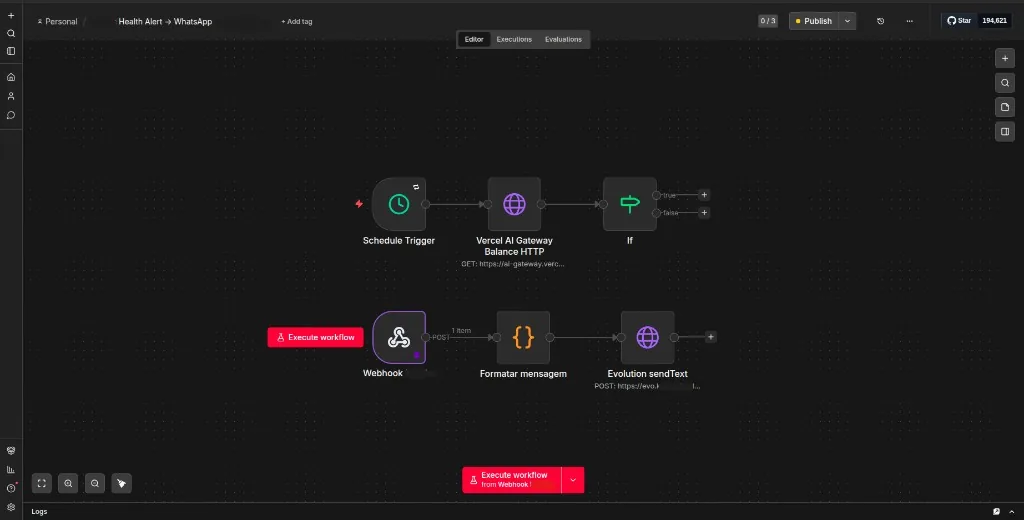
The bottom path is the workhorse: an inbound webhook receives an event, a small code node formats the message, and an HTTP step fires the outbound text — the kind of weekend ping an SDR would otherwise type by hand. The top path is guard-rail ops: a schedule trigger checks an external balance endpoint and branches on the result so you find out something is wrong before leads silently fail.
Neither flow is exotic. That is the point. Self-hosting here is not about running n8n for sport — it is about owning credentials, hitting a private CRM API, and not paying per execution while a client’s pipeline moves on Saturday night without a human refreshing a board. My DevOps tax on this pair is closer to the one bad hour a month band than six hours a week, because both flows are narrow, tested, and boring once live.
Hidden Costs Nobody Puts in the Comparison Post
Beyond infrastructure and founder time, a few line items catch solo operators off guard.
Credential and Webhook Churn
Every migration or domain change forces credential re-auth and webhook URL updates in external systems. Stripe, Shopify, HubSpot, custom apps — they all need to point at the new endpoint. This is tedious, not difficult. Budget an afternoon if you have more than ten integrations.
Community Nodes vs Cloud Restrictions
Cloud Starter does not include community nodes. If your workflow depends on a community integration, you are already pushed toward self-hosting or a higher tier. Check this before you build, not after.
AI Workflow Costs
n8n Cloud includes AI Workflow Builder credits on paid plans. Self-hosted still routes inference to OpenAI, Anthropic, or whatever you wire in. Your automation bill is automation bill plus model bill. I have seen founders celebrate a $4 VPS while spending $80/month on GPT-4o calls inside workflows.
Security Incidents Are Binary
A misconfigured n8n instance exposed to the internet without auth is a data breach waiting to happen. Self-hosting means you own patch cadence, access control, and secrets management. Cloud shifts much of that burden to n8n’s team. For founders handling customer data, this is not abstract — it is the difference between a quiet month and a very bad week.
My Practical Recommendations by Stage
Pre-revenue / exploring: n8n Cloud Starter trial. Ship fast. Do not self-host on day one unless you already have infra running for other reasons.
Early revenue, under 5K executions: Cloud Starter or managed pod ($3–4/month). Optimize for focus. Revisit when you hit 70% of execution cap two months in a row.
Growing, 5K–50K executions: Managed self-host or DIY Hetzner. Cloud Pro at €50–60/month is defensible if ops time is truly zero, but unlimited executions on a $4 box usually wins the cash argument.
Multiple products, client automations, strict data ownership: DIY on Hetzner with PostgreSQL, automated backups, and monitoring. Document runbooks even if you are the only reader. Future you will be grateful.
Non-technical co-founder depends on the tool: Bias Cloud Pro. The polish and support paths matter more than $30/month savings.
Conclusion: Self Host n8n Cost vs Cloud Is a Time Trade, Not a Price Trade
When you strip away the forum debates, self host n8n cost vs cloud comes down to what you are buying. Cloud buys boring infrastructure and predictable caps at €20–60/month. DIY self-hosting buys unlimited executions at $4–5/month plus a recurring founder time tax that realistically lands around 4–6 hours per month when you include monitoring, backups, and the occasional fire drill. Managed pods split the difference: near-cloud convenience at near-VPS prices, with a smaller vendor risk profile to evaluate.
There is no morally superior choice. There is only the choice that matches your execution volume, your tolerance for being on-call, and what your next hour is worth. I run self-hosted stacks for high-volume production workflows and have paid for Cloud when speed mattered more than savings. Both decisions were correct at the time.
Model all three buckets — cash, time, risk — before you migrate. Automations should make your business quieter. If the hosting decision makes your weeks louder, you picked the wrong invoice to optimize.
Frequently Asked Questions
Is self-hosting n8n really cheaper than n8n Cloud?
Infrastructure-only, yes — almost always. A Hetzner VPS runs $4–5/month and managed pods like InstaPods or PikaPods run $3–4/month, versus €20–24/month for Cloud Starter. But when you add an illustrative 4–6 hours/month founder time tax at any reasonable hourly rate, Cloud Starter can be cheaper in total economic cost for low-volume founders. Above roughly 5,000 executions per month, self-hosted infrastructure savings usually dominate.
How hard is it to migrate from n8n Cloud to self-hosted?
Technically straightforward, operationally annoying. Export workflows as JSON from Cloud, import into your self-hosted instance, and re-enter all credentials manually because encrypted secrets do not export. Update webhook URLs in every external service that calls into n8n. Most technical founders complete this in 60–90 minutes. Plan a maintenance window if any workflow is Tier A critical.
Can I start on Cloud and move to self-hosted later?
Yes, and that is often the best path. Use the 14-day Cloud trial or Starter plan to validate workflows, then migrate when execution volume or community node requirements push you past Cloud’s value curve. There is no lock-in on workflow logic — JSON exports are portable. The friction is credentials and webhook endpoints, not the workflows themselves.
Disclaimer: This article provides general information based on publicly available pricing and personal operational experience. It is not professional, financial, or legal advice. Infrastructure costs, platform pricing, and your specific technical requirements may differ. Evaluate your own risk tolerance and compliance needs before handling production or customer data on any platform.
Keep reading

Can a Non-Coder Actually Ship With Cursor? A Developer’s Honest Test
Cursor is not no-code. Here is what a non-technical founder can realistically ship in weeks — and when you still...

reMarkable vs Boox vs Kindle Scribe: Which One Actually Replaces the Note Vault You Abandoned?
An honest, spec-and-review-based comparison of reMarkable, Boox, and Kindle Scribe for anyone who quit Obsidian or Notion and wants notes...

6 Books That Actually Changed How I Run a One-Person Business (2026)
Not a top-20 listicle. Six books I actually read and applied while running a one-person AI business, and the one...

Do Phone Lock Boxes Actually Work for Founder Focus? The Commitment-Device Case
A clear-eyed look at whether phone lock boxes help a one-person founder focus — grounded in commitment-device research, with free...
The ‘Second Brain’ is Over: Why You Need a Second Executioner
Stop hoarding notes and start shipping. Discover why the Second Brain fails and how the Second Executioner model uses Personal...

Building a Personal Holding Structure for 3-5 Small Business Bets
Once you own 2-plus income-producing assets, a personal holding LLC structure gives small operators a treasury layer that reduces self-employment...
You've reached the end — no more posts to load.
No comments yet — be the first to share your thoughts.