

Best Free CRM Options for Bootstrapped Founders
Best free CRM options for bootstrapped founders: avoid overspending early and choose a $0 or low-cost CRM that fits your team and sales motion.

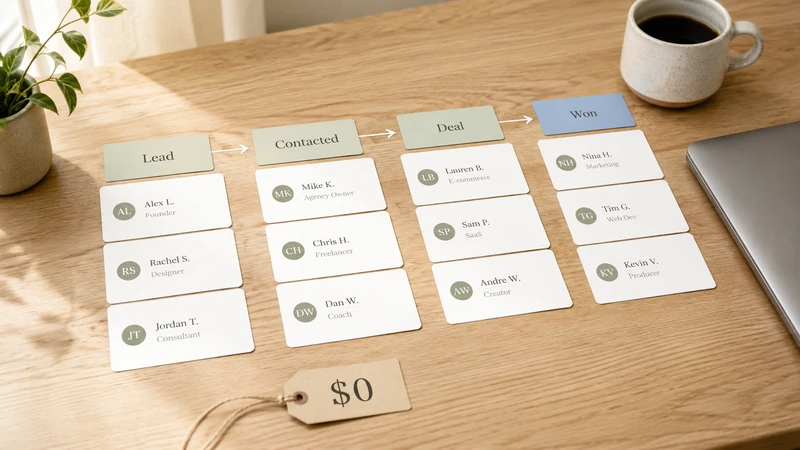
A bootstrapped founder can burn a surprising amount of money before revenue gets predictable, and sales software is one of the easiest places to overspend. Here is the thesis in plain English: you do not need to overbuy sales software early. A free or low-cost CRM can handle the first stage of selling, keep startup costs under control, and give you enough structure to follow up consistently. The best choice is usually not the most prestigious brand. It is the one that fits your team size and the way you actually sell.
That matters when you are already feeling overwhelmed and cautious about spending. The wrong CRM creates two problems at once: a new monthly bill and a system your small team may not even use. The right one gives you a clean place to track leads without forcing enterprise habits onto a tiny company.
Treat sales tools as part of startup budgeting
Most founders know they need to budget for legal setup, contractors, equipment, and marketing. Sales tools often get treated like something to figure out later, after leads start coming in. That delay sounds harmless until customer conversations are scattered across inboxes, notes apps, and memory.
The U.S. Small Business Administration argues for a more deliberate approach. In its startup cost guidance, the SBA says founders should calculate startup costs before launch and explicitly includes advertising and marketing among common startup expenses. That supports a simple idea: your sales system belongs in the budget from the beginning, even if your planned spend is zero.
This is where bootstrapped founders can save themselves from a common mistake. If you wait until the pipeline feels messy, you are more likely to buy under pressure. Buying under pressure usually means paying for features you have not earned yet. A founder with a handful of active deals does not need a heavyweight setup. They need one place to store contacts, track next steps, and make sure warm leads do not vanish into the digital couch cushions.
Treating CRM as part of startup budgeting changes the decision standard. Instead of asking which platform looks most advanced, ask which credible tool keeps your process organized at the lowest reasonable cost. That framing fits the economics of a bootstrapped business. It also sets up the next question: if low-cost tools are the smarter starting point, why do so many small businesses still delay CRM adoption?
Cost and complexity make simple CRM adoption the right first move
The answer is not laziness. Small businesses often avoid CRM because the tools feel expensive, complicated, or heavy relative to the work they need done.
The SBA addresses that directly in its discussion of CRM implementation problems, and it includes this quote from Brent Leary:
“CRM adoption by small businesses definitely lags that of larger companies.” – Brent Leary, CRM analyst and partner at CRM Essentials, quoted by the U.S. Small Business Administration
That line matters because it names the reality without shaming the reader. If smaller companies lag, the issue is not that founders are unserious. The issue is that adoption has real barriers. In the same SBA discussion, cost and complexity are identified as major implementation problems. For a lean team, those two barriers are enough to kill a tool before it becomes useful.
A simple entry point is usually the right first move because early-stage CRM success depends less on feature depth and more on whether people use it every day. If logging a contact, updating a deal, and setting a reminder takes seconds, the system has a chance. If setup feels like a side project with a training manual, the team will drift back to spreadsheets and inbox searches.
This is also the emotional turning point for many founders. Relief starts when you stop treating the first CRM like a permanent marriage. Early on, you need a spreadsheet replacement or a tiny shared pipeline, not a monument to future scale. Once that clicks, the free and low-cost end of the market looks much more practical.
Credible free and low-cost CRM options give founders real choice
Once you look past the branding, the market gets friendlier. Several established vendors offer real entry points for founders who need structure without a painful software bill.
HubSpot is the clearest example. According to HubSpot’s official pricing page, $0 – HubSpot’s CRM is available at no cost. HubSpot states the offer in exact terms:
“Yes, it’s 100% free. Forever.” – HubSpot, Official HubSpot CRM pricing statement
Zoho is especially relevant for a very small team. According to Zoho’s official pricing page, Free forever for 3 users – Zoho CRM’s free edition supports a small team. Zoho says it this way:
“Free forever for 3 users.” – Zoho, Official Zoho CRM pricing statement
Freshsales gives founders both a free starting point and a visible upgrade path. According to Freshworks’ official pricing page, $0 for 3 users – Freshsales offers a free plan for small teams. In the same Freshworks pricing page, $9/user/month billed annually – Freshsales paid pricing starts at an accessible entry point. Freshworks summarizes the free tier like this:
“Free plan $0 for 3 users” – Freshworks, Official Freshsales pricing statement
Brevo removes one more layer of friction for founders who hate trial traps. According to Brevo’s official pricing page, Free forever, no credit card needed – Brevo offers a free plan without requiring a credit card. Brevo describes it in the same words:
“Free forever, no credit card needed” – Brevo, Official Brevo pricing statement
This section is where the decision gets simpler. You are not choosing between serious software and amateur software. You are choosing among several credible low-cost starting points. That means budget no longer has to force a bad decision. Fit becomes the real filter.
If you are choosing now, the practical move is to start with the free plan that fits your team today, then upgrade only when the workflow demands it.
Match the CRM to your stage, team size, and sales motion
The best free CRM option for a bootstrapped founder depends on what stage the company is in and how selling actually happens.
If you are a solo founder who mostly needs a spreadsheet replacement, HubSpot is a reasonable starting point because, according to HubSpot’s official pricing page, $0 – HubSpot’s CRM is available at no cost. A solo operator can get basic structure without adding software spend.
If you already have a tiny team sharing leads, Zoho deserves attention because, according to Zoho’s official pricing page, Free forever for 3 users – Zoho CRM’s free edition supports a small team. That makes it a cleaner fit when visibility across two or three people matters more than advanced automation.
If you want a low-cost upgrade path in view from day one, Freshsales stands out because, according to Freshworks’ official pricing page, $0 for 3 users – Freshsales offers a free plan for small teams, and $9/user/month billed annually – Freshsales paid pricing starts at an accessible entry point. That gives a founder a way to forecast the next step instead of guessing what growth will cost.
If the biggest obstacle is simply getting started, Brevo has a practical advantage because, according to Brevo’s official pricing page, Free forever, no credit card needed – Brevo offers a free plan without requiring a credit card. Less setup friction means a higher chance the tool actually gets adopted.
The decision rule is straightforward. Buy for the stage you are in, not the stage you want investors to imagine. Bootstrapped founders do not need to overbuy sales software early. A free or low-cost CRM can cover the first stage of selling while protecting cash, and the smartest choice depends on team size and sales motion rather than brand prestige.
That should leave you feeling confident and in control of the budget. Choose the tool that matches your current workflow, keep costs lean, and upgrade only when your process clearly outgrows the free tier.
Subscribe for more bootstrapped founder tool guides that help you spend less before you scale.
Comment with your team size and sales motion, and I will suggest which free or low-cost tool fits best?
Sources
- Calculate your startup costs | U.S. Small Business Administration
- 3 Biggest Problems Implementing a CRM System, and What to Do About Them | U.S. Small Business Administration
- Free Tools | HubSpot
- Zoho CRM Pricing and Editions – Free for 3 users
- Freshsales Pricing & Plans | Freshworks
- Pricing Plans | Brevo
Keep reading

Can a Non-Coder Actually Ship With Cursor? A Developer’s Honest Test
Cursor is not no-code. Here is what a non-technical founder can realistically ship in weeks — and when you still...

Self-Hosting n8n: The Real Cost vs Cloud (and the 6 hrs/week DevOps Tax)
A founder-facing TCO teardown of n8n Cloud vs self-hosted infra — including the DevOps hours nobody puts in the spreadsheet.

reMarkable vs Boox vs Kindle Scribe: Which One Actually Replaces the Note Vault You Abandoned?
An honest, spec-and-review-based comparison of reMarkable, Boox, and Kindle Scribe for anyone who quit Obsidian or Notion and wants notes...

6 Books That Actually Changed How I Run a One-Person Business (2026)
Not a top-20 listicle. Six books I actually read and applied while running a one-person AI business, and the one...

Do Phone Lock Boxes Actually Work for Founder Focus? The Commitment-Device Case
A clear-eyed look at whether phone lock boxes help a one-person founder focus — grounded in commitment-device research, with free...

The ‘Second Brain’ is Over: Why You Need a Second Executioner
Stop hoarding notes and start shipping. Discover why the Second Brain fails and how the Second Executioner model uses Personal...
You've reached the end — no more posts to load.
No comments yet — be the first to share your thoughts.