

Vietnam Geoarbitrage: The 0.30 Price Ratio Explained (2026)
Vietnam's price level ratio is about 0.30 vs the US — each dollar buys ~3x the lifestyle. The real Da Nang math for founders, plus the honest caveats.


You are working harder than ever, yet your bank account feels like a leaky bucket. In Austin, New York, or London, the cost of simply existing eats the margin you need to build anything. You earn in a strong currency, and it vanishes into rent, insurance, and mediocre coffee. But what if the problem isn’t your income — it’s the geography of your expenses? Vietnam is one of the strongest cost-of-living arbitrage plays available to USD earners in 2026, and the case rests on one number most people have never heard of.
The Price Level Ratio: what 0.30 actually means

Most remote workers judge a destination by the exchange rate. The sharper metric is the Price Level Ratio (PLR), published by the World Bank: the ratio of a country’s purchasing power parity conversion factor to its market exchange rate. In plain terms, it measures how far your dollar actually goes when it hits the ground.
Vietnam’s PLR sits around 0.30 relative to the United States. For the same basket of goods and services, you are paying roughly 30 cents on the dollar compared to what you would spend in America. The exchange rate already prices in nothing like this — it is the local cost structure (labor, food, rent) that stays decoupled from Western inflation.
When you earn in USD and spend at a 0.30 price level, you are not “traveling cheap.” You are exploiting a durable macroeconomic gap — the same logic, at country scale, behind why founders quietly relocate to friendlier jurisdictions.
What $1,200 a month actually buys in Da Nang (2026 numbers)

There is a lingering myth that a low cost of living requires a sacrifice in quality of life. In Vietnam’s nomad hubs, the data says otherwise. Pulling together 2026 cost reports from Nomad Expenses and Nomads.com, a realistic Da Nang budget looks like this:
- Modern one-bedroom near My Khe beach: $400–550/month (inland studios run $250–350)
- Food and coffee (mix of Vietnamese eats and Western cafes): $250–350
- Coworking hot desk: $80–120
- Scooter rental + Grab: $50–80
- Gym, massages, day trips, lifestyle: $150–250
Total: roughly $950–1,350/month for a comfortable beach-city setup with fast fiber internet — infrastructure that genuinely rivals Western tech hubs. The same lifestyle in Austin or San Diego — beach proximity, daily eating out, gym, weekly massage — runs $4,000–5,000. That is the PLR showing up in your actual bank statement.
Be honest about the floor, though: the “$500/month luxury” claims you see on YouTube describe the rent line, not the whole budget. Real comfortable budgets start around $1,000.
The strategic runway: how a $1,200 burn rate changes founder math

For early-stage founders and freelancers, the greatest threat to a business is not a lack of ideas — it is a lack of time. A $4,000/month burn rate in a Western city forces you to take bad clients and boring gigs just to pay rent. Cut that burn to $1,200 and the same savings account suddenly buys 3x the runway:
- $36,000 saved = 9 months of runway in Austin
- $36,000 saved = 30 months of runway in Da Nang
Thirty months is enough time to take a product from zero to first $1K MRR several times over — and it dramatically lowers the real MRR number you need before quitting your job, because that number is a multiple of your monthly burn. When survival is guaranteed for a fraction of the cost, your appetite for risk goes up and your ability to focus on long-term growth follows.
Practical first step: book a monthly rental near My Khe for one month before signing anything longer — local prices negotiated on the ground are consistently below what booking platforms show.
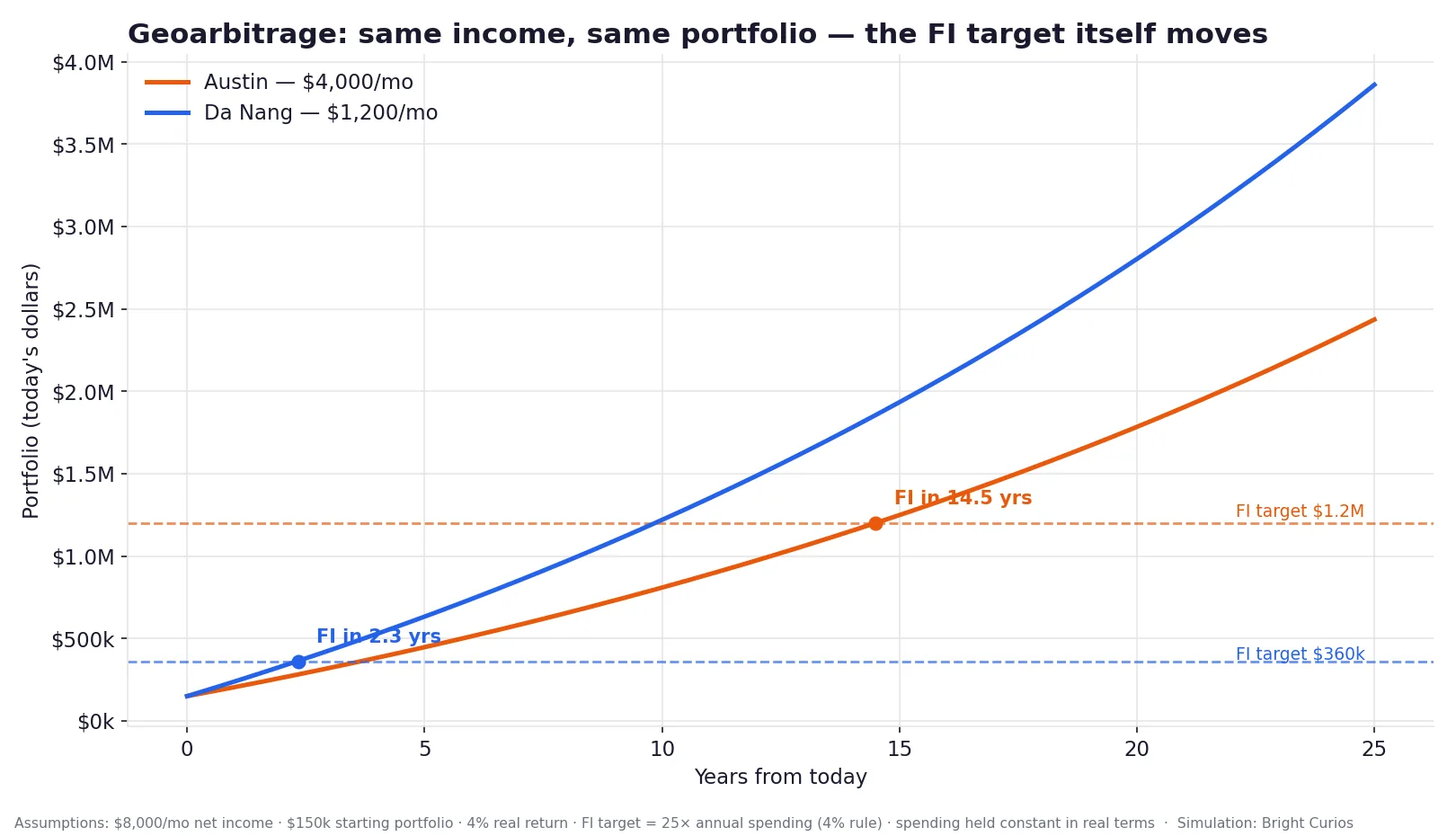
We modeled this with a simple simulation (assumptions in the chart footer): same $8,000/month net income and the same $150k starting portfolio, spending $4,000/month in Austin versus $1,200/month in Da Nang. Because lower spending also shrinks the FI target itself (25× annual spending), the gap is dramatic: FI in 2.3 years in Da Nang versus 14.5 years in Austin. Cost of living is the only variable that moves both sides of the FI equation at once.
The honest caveats nobody puts in the thumbnail
Geoarbitrage is real, but the 2026 version comes with fine print:
- Visa runs are a recurring cost. Vietnam still has no true digital nomad visa; most nomads cycle 90-day e-visas. At one border run per quarter, budget roughly $480–720/year in visa costs and travel.
- Prices are rising. Da Nang has boomed since 2025 — tourists, nomads, and real estate speculation are pushing rents up. The 0.30 ratio is durable; the $400 beach apartment may not be.
- Taxes don’t disappear. US citizens still file with the IRS (FEIE may help); stay 183+ days and Vietnamese tax residency can enter the picture. Get advice before you commit.
- Vietnam is not the “only” play. Mexico, Portugal, Thailand, and Malaysia all offer versions of the same trade, with different visa friction and price levels. Vietnam currently combines one of the lowest PLRs with genuinely modern infrastructure — that combination, not magic, is the edge.
The math favors your freedom either way: you can keep paying first-world prices for the privilege of grinding, or you can move your burn rate to a place where every dollar does triple duty.
Sources
Keep reading

Can a Non-Coder Actually Ship With Cursor? A Developer’s Honest Test
Cursor is not no-code. Here is what a non-technical founder can realistically ship in weeks — and when you still...

Self-Hosting n8n: The Real Cost vs Cloud (and the 6 hrs/week DevOps Tax)
A founder-facing TCO teardown of n8n Cloud vs self-hosted infra — including the DevOps hours nobody puts in the spreadsheet.

reMarkable vs Boox vs Kindle Scribe: Which One Actually Replaces the Note Vault You Abandoned?
An honest, spec-and-review-based comparison of reMarkable, Boox, and Kindle Scribe for anyone who quit Obsidian or Notion and wants notes...

6 Books That Actually Changed How I Run a One-Person Business (2026)
Not a top-20 listicle. Six books I actually read and applied while running a one-person AI business, and the one...

Do Phone Lock Boxes Actually Work for Founder Focus? The Commitment-Device Case
A clear-eyed look at whether phone lock boxes help a one-person founder focus — grounded in commitment-device research, with free...

The ‘Second Brain’ is Over: Why You Need a Second Executioner
Stop hoarding notes and start shipping. Discover why the Second Brain fails and how the Second Executioner model uses Personal...
You've reached the end — no more posts to load.
No comments yet — be the first to share your thoughts.