

Invisible Wealth Protocol: Protect Your Portfolio Abroad
Carry a $1M portfolio through $10/day neighborhoods without becoming a target: device compartmentalization, decoy wallets, and a 60-second kill switch.


The Wealth-Visibility Gap: Why Mobile Investors Are Targets
You spent a decade building a portfolio to free your time. You hit your FIRE number, packed a 40L bag, and headed for a low-cost paradise. But there is a hidden tax on the nomadic lifestyle that most financial advisors ignore: the gap between how much you carry and how visible it is.
The money side of this threat is growing fast. The FBI’s Internet Crime Complaint Center (IC3) 2023 report recorded $3.96 billion in losses to cryptocurrency investment fraud alone — a 53% jump in a single year — alongside record overall investment-fraud losses. At the same time, the pool of mobile targets keeps expanding: MBO Partners’ State of Independence research counts more than 18 million Americans who now describe themselves as digital nomads. We are wealthier, more mobile, and more visible than ever.
And the visibility problem starts before you even board a plane: if you broadcast your portfolio milestones and beach office online, you are building a public dossier of your wealth (a cousin of the problem we covered in why social media might be hurting your FIRE dreams).
When you carry your entire financial life in a backpack, your hardware footprint is your biggest liability. Privacy specialist Michael Bazzell — a former FBI cyber task force investigator and author of Extreme Privacy — builds his entire methodology around one idea: what people can see determines what they attack. If your bag looks like it costs $5,000, people assume the accounts behind it are worth far more.
The protocol below has three pillars: digital compartmentalization, physical decoys, and a practiced kill switch.
Pillar 1: Digital Compartmentalization
The most dangerous mistake a mobile investor can make is using a single device for everything. If your primary phone contains your email, your 2FA apps, and your brokerage login, it is not a tool — it is a single point of failure. The pattern showed up repeatedly in reporting on phone-theft waves in London and U.S. cities: thieves who watch you type your passcode, snatch the phone unlocked, and drain accounts before you reach a police station.
The Invisible Wealth Protocol requires strict compartmentalization:
- The Daily Driver: a mid-range phone with no financial apps, no saved passwords for brokerages, and only enough cash in a spending account to cover a week.
- The Vault: a separate, hardened device (an older iPhone or iPad works) that stays at your accommodation, powered off, used only for financial transactions.
- Hardware keys: replace SMS-based 2FA with hardware security keys. A YubiKey cannot be SIM-swapped, and it requires physical presence to authorize an exit of funds.
Two practical additions that cost nothing:
- Full-disk encryption on every laptop (FileVault, BitLocker) — an encrypted stolen laptop is a paperweight, not a breach.
- Separate email addresses: one public, one used exclusively for financial institutions and known to no one.

Pillar 2: Physical Decoy Strategies
Security is as much about psychology as it is about technology. In tourism hubs, opportunistic property crime follows visible high-end tech — the MacBook on the beach-bar table is the advertisement.
Adopt the “Grey Man” strategy:
- Hardware camouflage: stickers or worn cases make high-end laptops look old or cheap.
- The decoy wallet: carry a secondary “mugger’s wallet” with expired cards and a small amount of local currency. If confronted, you hand over something that costs you $20, not your real cards.
- The burner phone: out late in a higher-risk area? Leave the primary device secured at home and carry a cheap phone for navigation.
- Card separation: never keep all payment cards in one place. One card lives in your accommodation safe; a single theft should never leave you cardless in a foreign country.
The same logic applies to where you choose to live and bank as a mobile founder — jurisdiction is part of the camouflage (see why founders flee: the countries entrepreneurs secretly prefer).

Pillar 3: The 60-Second Kill Switch
If a theft occurs, you are in a race against the clock. Sophisticated thieves use “shoulder surfing” to watch you enter your passcode before grabbing the device. With that passcode, they can reset your Apple ID or Google account and lock you out of your own backups.
Your 60-second workflow must be practiced — actually rehearsed, not just written down:
- Step 1: Access a secondary secure device (The Vault).
- Step 2: Use Find My or Google’s “Erase Device” immediately.
- Step 3: Freeze withdrawals: change the password on your primary email first (it is the master key to everything), then lock your brokerage and bank accounts.
- Step 4: De-authorize the stolen device in every account’s active-sessions list.
Run the drill once a quarter. The first time you do it should not be at 2 a.m. in a police station.
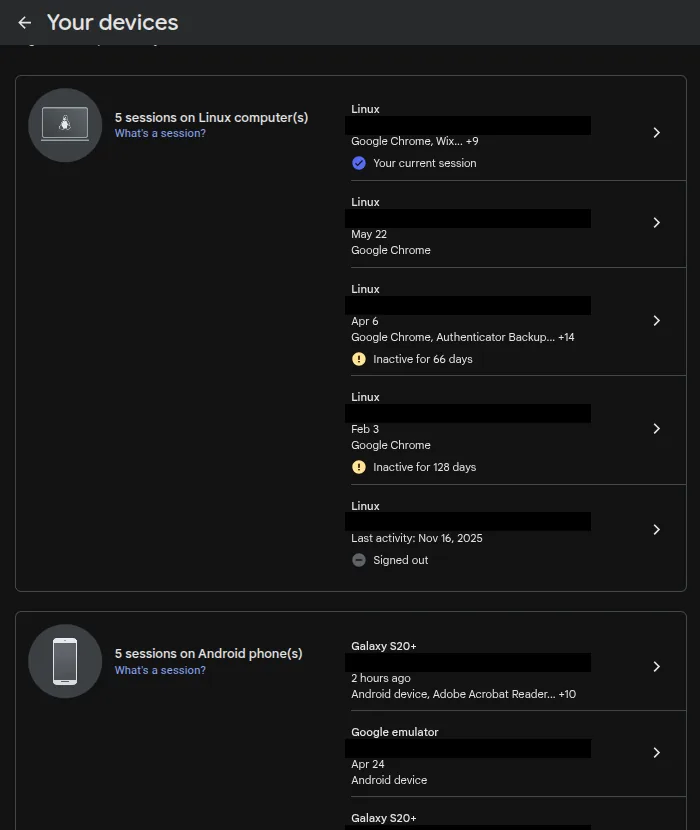
I ran this exact drill on my own Google account while writing this post. The audit turned up ten authorized sessions — and two of them had been sitting there inactive for 66 and 128 days, logins on machines I had genuinely forgotten existed. Nothing dramatic happened to convince me; that’s the point. The forgotten session you de-authorize on a calm Tuesday is the one that can’t be used against you the week your phone disappears abroad.

The Bigger Picture: Protect the Plan, Not Just the Devices
Device security is the acute risk; plan fragility is the chronic one. A theft that costs you $3,000 of hardware is annoying. A panic that makes you liquidate investments at the bottom, or a portfolio so concentrated that one bad event wrecks it, costs years. If your FI number leans on illiquid assets, pressure-test it — starting with how you count business equity in your FI number.
Invisible wealth is not paranoia. It is the same principle as diversification: never let a single point of failure — a device, a wallet, a password — stand between you and the freedom you already earned.
Sources
- FBI Internet Crime Complaint Center (IC3) — Annual Internet Crime Reports. 2023 report: $3.96B in cryptocurrency investment fraud losses, up 53% year-over-year.
- MBO Partners — The State of Independence in America. Digital nomad population tracking (18M+ American digital nomads).
- Michael Bazzell — Extreme Privacy: What It Takes to Disappear (4th edition). Compartmentalization methodology referenced in Pillar 1.
Keep reading

Can a Non-Coder Actually Ship With Cursor? A Developer’s Honest Test
Cursor is not no-code. Here is what a non-technical founder can realistically ship in weeks — and when you still...
Self-Hosting n8n: The Real Cost vs Cloud (and the 6 hrs/week DevOps Tax)
A founder-facing TCO teardown of n8n Cloud vs self-hosted infra — including the DevOps hours nobody puts in the spreadsheet.

reMarkable vs Boox vs Kindle Scribe: Which One Actually Replaces the Note Vault You Abandoned?
An honest, spec-and-review-based comparison of reMarkable, Boox, and Kindle Scribe for anyone who quit Obsidian or Notion and wants notes...

6 Books That Actually Changed How I Run a One-Person Business (2026)
Not a top-20 listicle. Six books I actually read and applied while running a one-person AI business, and the one...

Do Phone Lock Boxes Actually Work for Founder Focus? The Commitment-Device Case
A clear-eyed look at whether phone lock boxes help a one-person founder focus — grounded in commitment-device research, with free...
The ‘Second Brain’ is Over: Why You Need a Second Executioner
Stop hoarding notes and start shipping. Discover why the Second Brain fails and how the Second Executioner model uses Personal...
You've reached the end — no more posts to load.
No comments yet — be the first to share your thoughts.